 |
| 'Saint Jerome and the Lion,' (detail), Liberale da Verona, 15th century. |
Biographical
Overview
St. Jerome was born in c.347 in what was then part of
north-eastern Italy. As a student in Rome, he traversed the boundaries of wantonness
and piety. Later he spent time living in Gaul, during which he is believed to
have taken up his first theological studies.
At about the age of 26 he set out on a journey through
Thrace and Asia Minor, residing for the most part at Antioch. There, during an
illness, he had a vision that “led him to lay aside his secular studies and
devote himself to God. He seems to have abstained for a considerable time from
the study of the classics and to have plunged deeply into that of the Bible”.[1]
However, he never forsook the seeds of truth, goodness and beauty he had
gleaned from the ancient classics. Since throughout his letters, even in his
old age, he continued to quote from them – above all from Virgil.[2]
 |
| Jan Hovaert, 1665-1668. |
Following his conversion of heart, Jerome started to live
an ascetic life in the desert of Chalcis. In 378 or 379 he returned to Antioch,
and against his preference was ordained a priest by Bishop Paulinus. He then
went to Constantinople, studying for two years under St. Gregory Nazianzus,
followed by three years in Rome as Pope St. Damascus’ protégé and secretary.
While in Rome Jerome was surrounded by a circle of
notable and well-educated Roman women who through his influence, longed for the
monastic life. The most well-known of these, are Saints Lea, Marcella and
Paula. Due to such acquaintances, in addition to a false allegation concerning
improper relations with the widow named Paula, and his unsparing criticism of
the worldliness of the clergy in Rome, he was soon compelled to leave Rome.
From Rome he went to Antioch, and then to Bethlehem.
There he ended up as the head of a small monastery, with an adjacent convent
where a group of women lived under St. Paula. Bethlehem remained Jerome’s home
for the next thirty-four years of his life and here he wrote the majority of
his works. Guiding numerous souls through his correspondences, and rebuffing
critics. With his letters enjoying a wide circulation in a crumbling Roman
Empire.
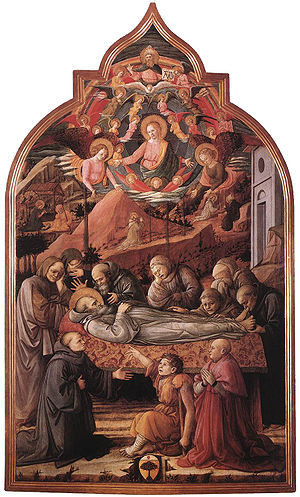 |
| 'Funeral of St. Jerome,' Filippo Lippi, 1452-1460. |
Yet it would be a mistake to think he lived all of these
final days in peace. For several years before his death, an angry mob raided
his monastic sanctuary, incumbent on exacting violence on Jerome for his
writings against the Pelagian heresy. In their wake they burnt the monastic
buildings and killed a deacon, but he himself was able to take refuge in a
nearby fortress, escaping unharmed. Four years later, in c.420 he died at the
age of 70.
Jerome’s Legacy
Since his death, Jerome has been recognised as an eminent
Church Father and as a Doctor of the Church. He is considered the patron of archeologists, archivists, biblical scholars, libraries, librarians, school children, students and translators. One can understand his patronages, since Jerome is responsible for translating
most of the texts of the Bible from Hebrew and Greek into Latin, in a
translation which was to be called the Vulgate. Even in his own day, he was
noted for his mastery of the scriptures, for his scriptural commentaries – on
various books of the Old and New Testaments; and for his numerous letters. St.
Augustine, who despite his at times rocky relationship of correspondence with
Jerome, referred to him in such titles as, “My Holy Brother” and “Fellow-Presbyter”, and stated
that “What Jerome is ignorant of, no mortal has ever known.”[3]
However, on the flip side of Jerome’s intellectual
prowess, linguistic eloquence, robust asceticism, spiritual mastery in matters
both abstract and practical, and his unwavering zeal for the faith, is the
portrait painted in regards to his personality: a stern, uncompromising man. Considered
at times to be excessive and exacting, who was a vehement satirist against his
doctrinal foes, and who had a boisterous temper.
Jerome’s
Tempestuous Side
Such negative depictions are not unfounded in the least,
for his correspondences prove he had a temper and a sharp pen. Although,
arguably, these ‘outbursts’ never seem to be totally unfounded or unprovoked. Nor
are they without their humour. A humour which it seems at times has been mistaken
by commentators for outright aggression.[4] Indeed,
as Andrew Cain points out, Jerome’s Letters are often read out of context. For
Jerome is writing in a time where letter-etiquette was perhaps even more sensitive
as swift replies to texts are today, and where reproach and a certain theatricality
were rhetorical devices utilised in ancient Greco-Roman correspondence, beyond
what is perceived today as outright ‘meanness’ and arrogant ‘show-man ship’.[5] Nevertheless,
in his letters there is ample evidence of his tempestuous side which is
impossible to deny.
In Letter 8 addressed to the sub-deacon Niceas Jerome almost
whinges about his failure to respond to his letters. He writes:
You, however, who have but just
left me, have not merely unknit our new-made friendship; you have torn it
asunder… Can it be that the East is so hateful to you that you dread the
thought of even your letters coming hither? Wake up, wake up, arouse yourself
from sleep, give to affection at least one sheet of paper.[6]
Elsewhere we see Jerome’s sharp pen at work again. In
c.396, he responds to Vigilantius who has accused him of the heresy of
Origenism:
Christian modesty holds me back
and I do not wish to lay open the retirement of my poor cell with biting words.
[Que the biting words:] Otherwise I should soon show up all your bravery and
your parade of triumph… for my own part as a Christian speaking to a Christian
I beseech you my brother not to pretend to know more than you do... the stench
of the bilge water has affected your head... If you wish to exercise your mind…
learn logic, have yourself instructed in the schools of the philosophers; and
when you have learned all these things you will perhaps begin to hold your
tongue… Accordingly I may seem to have been somewhat more acrid in this latter
part of my letter than I declared I would be at the outset. Yet… it is
extremely foolish in you again to commit a sin for which you must anew do
penance. [7]
Angry-Jerome: A
Popular Portrait
A rather ‘lovely’ synopsis of Jerome’s character is
provided in volume six of the Prolegomena to Hendrickson Publisher’s Nicene
and Post-Nicene Fathers, drawing from William Smith’s Dictionary of
Christian Biography:
He was vain and unable to bear
rivals, extremely sensitive as to the estimation in which he was held by his
contemporaries, and especially by the Bishops; passionate and resentful, but at
times becoming suddenly placable; scornful and violent in controversy; kind to
the weak and the poor; respectful in his dealings with women; entirely without
avarice; extraordinarily diligent in work… There was, however, something of monkish
cowardice in his asceticism…[8]
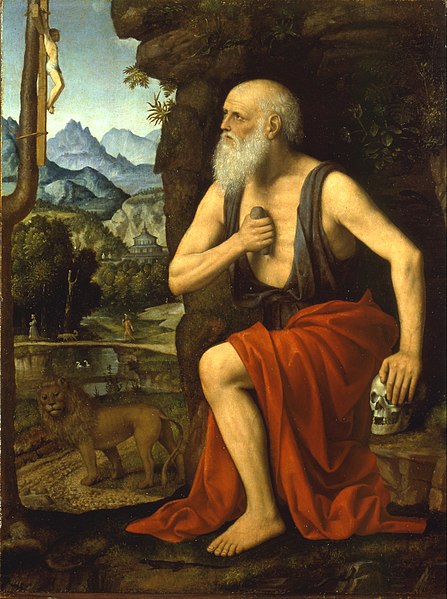 |
| 'St. Jerome in Penitence,' Bernardino Luini, ~1525. |
And perhaps it suffices to end there, for despite some
unvarnished truths, it would do well to spare ourselves from some of the additional
nonsense written thereafter (concerning anti-middle age polemic in reference to
Jerome’s medieval legacy). But from this slightly biased portrait, we can see
the sort of portrait that is painted of Jerome. A portrait – one shade the less
here, one shade the more there – which is by far the most common, and which has
been perpetuated throughout the centuries, even until today, helped along in
recent times by J. N. D Kelly’s biography on Jerome.[9]
However, it is his apparent humility grounded in
self-awareness, and in his instance, manifested in a monastic life of penance
and prayer, that has generally been presented as his saving grace – the seal of
which is his sound, rich and scripturally charged doctrine. A saving grace which
we might say can be symbolised by a stone. For, Pope Sixtus V (1585-90) having
stopped before a painting of the penitent Jerome striking his breast with a
stone, is said to have wryly remarked, “You do well to carry that
stone, for without it the Church would never have canonized you”.[10]
What’s So
Appealing About this Grumpy Old Man?
It is often refreshing to hear of the human imperfections
that plagued the saints – a reminder that sanctity isn’t synonymous with
middle-class respectability, and that God can work with the most unworkable
clay. As Paul says, “Moreover we have this treasure [of Christ and His glory]
in earthen vessels, to show that the surpassing power and ableness belongs to
God and not to us.” (2 Cor 4:7).[11] This
is among the reasons why the narrative of Jerome’s imperfections, above all the
trait of his temper, has been passed down to us until this day.
 |
| 'Jerome,' Lucas Cranach the Elder, 16th Century. |
It’s also uncommon for glimpses of the raw humanity of
the saints to be had – especially if they lived so long ago. Indeed, the legacy
of the saints might be said to generally become more polished as the ages tick
by. For in the absence of written evidence, or the lack thereof, of their
unpolished side, in combination with a historical separation from the oral
traditions surrounding the lives and characters of such saints – first
furnished in their earliest devoted following, but which frequently wanes indefinitely,
or periodically in subsequent generations – it seems only reasonable that
accounts pertaining to their imperfections might easily be lost through the
sift of time. Especially when pious consciousness typically favours the grand
and glorious deeds of the saints.
However, because of the Letters of Jerome,
we have a rare and honest insight into a man who’s not shy to showcase his
views and personality – warts and all – in his various correspondences. Hence,
having abounding evidence of Jerome’s ‘unpolished side’, his fragility is
almost championed, at once frowned upon – to the extent that his sainthood has
been questioned – and found amusing, exaggerated and frequently
taken out of context.[12] Meanwhile
Jerome serves as a kind of archetype of the ordinary humanity of the saints –
and that the God of holiness can flourish in the midst of our imperfection. Not
so much in spite of it, but to some extent because of it.
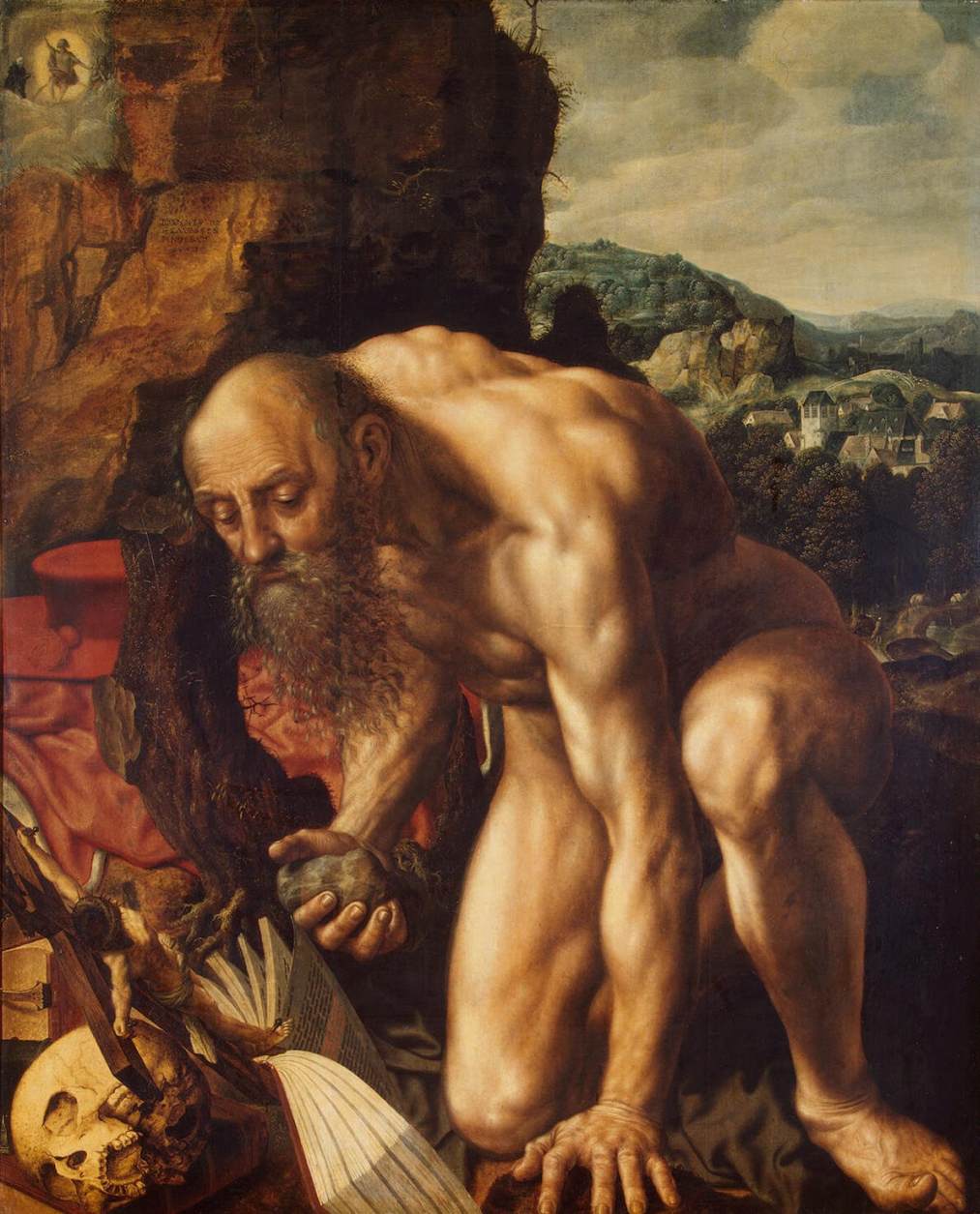 |
| 'St. Jerome,' Jan van Hemessen, 1543. |
Not that imperfection in and of itself necessarily begets
God’s favour; but that faith and trust in God in the face of our imperfection,
in the context of our sincere struggle to live the spiritual life, causes our
imperfections to turn from things that work against us, to things that work in
our favour (Rom 8:28). Just as the wounds of a sick man almost endear the
doctor’s attention towards him, by which he wins not only medical assistance,
but personal contact. Or as the smelly nappy of an infant draws its mother to
lovingly tend to it – to clean and freshen it, and to end by caressing and
hugging it. Shows of affection which the smelly nappy incidentally caused!
Likewise, our imperfections – those minor but persistent
blemishes in our personality and habits, which no matter what, seem to cling to
us like skin to a skinny face – surrendered to God with repentance, and borne
in happy trust that God loves us and will deliver us; cease to work against our
sanctification and start to work for it. Even to the point of edifying our
neighbours, in some mysterious and roundabout way! After all, Jerome’s temper is
edifying us over fifteen hundred years later in regards to the goodness and
mercy of God!
Sure, some might use Jerome to justify bad habits, and
others might miss the point completely by snarling at him as ‘a saint who just
got through the door’. But this isn’t what pointing out his temper is supposed
to do. It supposed to encourage us, and console us, that whilst we remain as
imperfect as we are despite our efforts and our surrendering to God – who alone
can make us holy – there is still hope for us. Not the wishful and watered down
hope thrown around by the world, which is simply doubt disguised as
positive-thinking – but the kind of hope that is sure and certain in the Person
of Christ. A hope which is the means of possessing what is believed. The very
kind of hope the Holy Spirit awakens in us, whenever we read the words of Paul
in faith: “When I am weak, I am strong.” (2 Cor 12:10); and before this, in the
same chapter, where Paul relates the words God said to him in the midst of
struggling with his ineptness to actualise his ideal of sanctity: “My power is
made manifest in weakness.” (2 Cor 12:8).
God’s
Tenderness and Jerome’s Temper
It's ironic that I started writing this article with the
intention of revealing the tender side to Jerome, and here I’ve written around
two thousand words, the majority of which revolve around his temper, without really
denying it, and without mentioning the word tender or its variants once within the body of the text.
Indeed, God’s Providence never fails. For although it
would seem that in order to make a case for Jerome’s tenderness would lie in setting
up arguments against Jerome’s temper, or at least by arguing he was less
tempestuous than is claimed – which on one level was partially my initial
intention – through the eyes of faith I cannot help but notice God is reminding
me as I write that “My power is made manifest in weakness”. Ergo, that God’s
tenderness, is made manifest in Jerome’s temper.
 |
| 'St. Jerome in Penitence,' Titian, 1575. |
Sure, as our Lord said, “God alone is good” (Mk 10:18) and
therefore, anything within us which is good, is ultimately attributable to God,
whilst anything bad, to our fallen will. Thus God’s tenderness – on loan to
Jerome, as Jerome’s tenderness – which is clearly discernible in his writings,
and is testified by his saintly status, clearly coexisted with his temper which
as far as we’re aware, remained with him until the grave. Serving him during his
lifetime, in similitude to St. Paul, as a kind of humbling thorn in his side,
perhaps permitted by God to endure for his sake “of not becoming too exalted by
the abundance of” his knowledge and the severity of his asceticism (2 Cor 12:7).
Yet the coexistence of God’s tenderness and Jerome’s own
temper, within the same single man, wasn’t in spite of his temper, it was
somewhat because of it. As we have said, God’s tenderness dwelt and was made
manifest in Jerome’s temper. For Jerome’s temper being like a thorn in his side,
would have, after it’s fuse was lit, brought about sorrow, contrition and
self-knowledge, and therefore humility and the fruit of its authenticity:
greater trust in God. We know this, because this is how a saint becomes a
saint. Not that they become perfect in the infallible sense; but that they know
how to carry their false-self with all its failings to the peak of Calvary, in
the confident joy of salvation in Christ their Groom – never flagging in zeal
for the truth, and never abandoning prayer, nor the hope of beatitude. Even
when everything inside and outside of them, in the midst of their sincere but
imperfect efforts, is screaming at them “It’s hopeless.”
Jerome’s
Temper: From A Source of Curse to A Source of Blessing
As we read in the Scriptures “A just man sins seven times
a day.” (Prov 24:16). Yet in keeping with Teresa of Avila’s understanding: with
the saints, having being sanctified to a considerable extent during their life,
their figurative seven sins, we might generalise to say, are either
imperfections, distinct from sin, or involuntary venial sins. The wounds of
imperfection or venial sin (almost certainly involuntary at least in his latter
years), caused by his moments of immoderate or unnecessary anger, would,
following his sorrow, acts of humility etc., thus have turned from wounds
causing harm to his soul, or at least as obstacles to greater sanctity, into vessels
in which God’s Power could dwell. In this instance, as such a wound would have
been caused by his temper, by means of the reversing principle of
sanctification, it would have become a vessel for God’s Tenderness.
This process would not have been wrought abstractly, but
through a spiritual union with the wounds of Christ – whose wounds were, are,
and ever will be, vessels of every grace and heavenly virtue. Such is the
seeming paradox of Christianity – wounds caused by violence and sin, in Christ
and by the Holy Spirit, become vessels of peace wherein abides the balm of redemption.
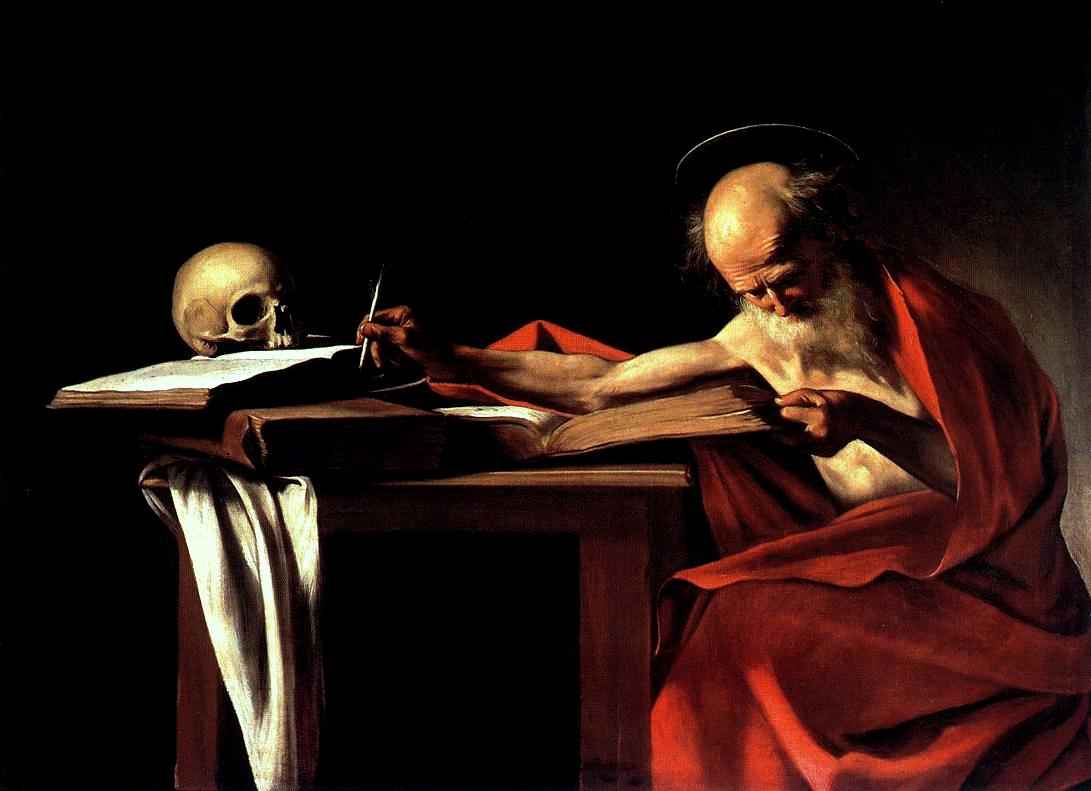 |
| 'Saint Jerome in His Study,' Caravaggio, 1605-1606 |
Hence Jerome’s temper, when it formed little wounds on
his soul, like pot holes on a road, became – through grace – the secondary means
by which he came to bear God’s tenderness within. With such grace likened to
rain when it fills pot holes and turns them into puddles. Puddles that reflect
the sun above when it glistens on their surface. Just as Jerome’s wounds caused
by anger, became through contrition and faith, like puddles for the Divine
tenderness, reflecting the light of God’s glory back unto Himself.
And indeed, even when a pothole becomes a puddle, the
pothole remains, just as Jerome’s temper – a natural inclination to anger
distinct from the act of anger itself – and weak moments of ‘losing it’, remained
throughout his life. Yet nevertheless, like Paul, St. Jerome could rejoice in
his weakness, because He knew that God’s tenderness was made manifest in his
temper. For who could attribute any shows of warmth and compassion, and tender
words, to a man known for his temper (and a hot temper at that!)? Especially if
such tenderness was nothing short of divine. Thus Jerome was an “earthen
vessel” to show the surpassing tenderness of God, for clearly it wasn’t his
own! (2 Cor 4:7).
Signs of Tenderness
in Jerome’s Letters
Before we conclude it seems only fair to provide some of
the written evidence of such tenderness – a tenderness he is not afraid to show.
Evidence which abounds in his extant Letters. We see Jerome’s tenderness
especially in his letters written in the consolatoria tradition. Particularly
in the letters of consolation, in the form of memoir, following the deaths of
the holy women whom he instructed in Rome. Some of whom followed him to
Bethlehem.
In Letter 127 addressed to Principia concerning St.
Marcella who died when the Visigoths sacked Rome in c.410. He writes:
I am so anxious myself to do
justice to her merits that it grieves me that you should spur me on and fancy
that your entreaties are needed when I do not yield even to you in love for
her.
 |
| 'The sack of Rome by the Barbarians 410,' Joseph-Noël Sylvestre, 1890. |
He then goes on to state that his failure to expound on
Marcella’s life, for over two years, was not out of “a
wish to ignore her” as Principia had supposed, but to an incredible sorrow
which so overcame my mind that I judged it better to remain silent for a while
than to praise her virtues in inadequate language.” Before he ends the letter
we read of the tender way he handles the death of Marcella, whom died in
Principia’s arms – her best friend mind you – not simply as a rhetorician, but
as a friend, and above all, as a compassionate pastor who loves and cares for
his spiritual children as nothing short of a father:
When she closed her eyes, it was
in your arms; when she breathed her last breath, your lips received it; you
shed tears but she smiled conscious of having led a good life and hoping for
her reward hereafter. In one short night I have dictated this letter in honour
of you, revered Marcella, and of you, my daughter Principia[13]
Elsewhere we see the divine tenderness at work. In Letter
66 Jerome writes to a Pammachius concerning the loss of his young wife: “For
who can ears so dull or hearts so flinty as to hear the name of your Paulina
without weeping?”.[14]
Furthermore, in his longest letter, addressed to console the
son of St. Paula and expounding on her life following her death, he writes:
I have spent the labour of two
nights in dictating for you this treatise; and in doing so I have felt a grief
as deep as your own. I say in 'dictating' for I have not been able to write it
myself. As often as I have taken up my pen and have tried to fulfil my promise;
my fingers have stiffened, my hand has fallen, and my power over it has
vanished. The rudeness of the diction, devoid as it is of all elegance or
charm, bears witness to the feeling of the writer. And now, Paula, farewell… In
this letter
I have builtto your memory
a monument more lasting than bronze,which no lapse of time will be able to destroy.[15]
And finally, perhaps my favourite portion of text that I
have come across in Jerome’s Letters, is in a letter addressed to
Gaudentius (and in some sense to Gaudentius’ newborn daughter) who had asked
advice on how to raise his infant daughter. In this letter we see the tender
side to Jerome – the heart of a man who has clearly been touched by the Infant
Christ through his meditations on the Gospels. Yet by no means is such
tenderness polished and carefully courteous, as the beginning of the extract will
show, which is quite amusing:
It is hard to write to a little
girl who cannot understand what you say… For how can you speak of self-control
to a child who is eager for cakes, who babbles on her mother's knee, and to
whom honey is sweeter than any words? Will she hear the deep things of the
apostle when all her delight is in nursery tales? Will she heed the dark
sayings of the prophets when her nurse can frighten her by a frowning face?
He then reveals his acute grandfather-like-care:
…To induce her to repeat her
lessons with her little shrill voice, hold out to her as rewards cakes and mead
and sweetmeats. She will make haste to perform her task if she hopes afterwards
to get some bright bunch of flowers, some glittering bauble, some enchanting
doll… Then when she has finished her lessons she ought to have some recreation.
At such times she may hang round her mother's neck, or snatch kisses from her
relations. Reward her for singing psalms that she may love what she has to
learn. Her task will then become a pleasure to her and no compulsion will be
necessary.[16]
Conclusion
 |
| 'Madonna and Child with Saints Jerome and Francis,' Paris Bordone, 1525. |
There is no denying that Jerome had a temper, and that he
often gave vent to it in less than ideal ways. Yet it is ludicrous to belittle
his sainthood on this basis. For one, we do not know the man personally, we
only have his letters which are written in a time different to our own, with its
own nuances of etiquette and humour. Two, his temper and his moments of
outburst enshrined in ink, may indeed often fall short of perfection, and there’s
no denying the frequent gruffness of his manner; but as far as we know, and the
Church seems to think it so, by the very fact of his canonisation, that he didn’t
wilfully inculcate his temper, or cling to his temper in pride, but rather it
was a thorn in his side! A wound that brought much suffering to his soul, and which
drove him into the desert of humility before his God. As such, the abiding
temper of Jerome, that he couldn’t seem to shake in spite of his penance and
prayers, testifies to his profound humanness. Which because he carried it with
such penitent humility, never wavering in his quest for God above, and in the
Presence of Jesus within the poor virgins and widows that relied on him as a
father, testifies to his profound saintliness. A raw and real saintliness which
in Jerome’s case looked like a grumpy old man around the edges and a tender
loving God in the middle.
In what is arguably Jerome’s last known letter, written to Augustine and Alypius - the date
of which we are certain, c.419 – we see his unpolished side, and the tenderness
of God at work. A tenderness expressed side by side with Jerome's usual gruffness. Although arguably in this instance it's more of a righteous than an unrighteous anger. He writes:
 |
| 'St. Jerome,' Palma the Younger, 1595. |
This after all is the grumpy old man who can write: the
stench of the bilge water has affected your head, and the tender old man
who can write: she [your infant daughter] may hang round her mother's neck,
or snatch kisses from her relations.
Indeed, in Jerome we see that the Scripture is truly
alive: “The wolf shall dwell with the lamb” (Is 11:6). It
is tempting to change ‘wolf’ to ‘lion’ to fit the popular stated but non-existent
biblical phrase: “the lion shall dwell with the lamb,” because Jerome is often
depicted beside a lion, based on a legend that he tamed a lion by healing its
paw. Yet Jerome, the stickler for accurate biblical translation, would not
approve, and we wouldn’t want to stir the lion…the wolf… I mean… the lamb who
is tender (and who had a temper).
[1]
Wikipedia, “Jerome,” https://en.wikipedia.org/wiki/Jerome#Life
[2] I.e.
Among the many references, see Letters of St. Jerome: 66.5, 122.12 and 125.11.
[3] In
regards to titles of correspondence, see Letters of St. Augustine, 28, 82.
[4] Take
for example his letter to Julian a deacon of Antioch, which might be read as a
brazen reproach of his friend’s quick judgement as to why Jerome was failing to
correspond with him. Yet, really Jerome seems to be joking, since after
providing several excuses, he confesses the truth behind the matter of his delay
– illness.
[5] Andrew
Cain, “‘Vox Clamantis in Deserto’: Rhetoric, Reproach, and the Forging of
Ascetic Authority in Jerome’s Letters from the Syrian Desert,” The Journal
of Theological Studies 57, no. 2 (2006): 501, accessed 21 Oct 2016,
http://www.jstor.org/stable/23971716. Despite personally disagreeing with
aspects of his position, which argues Jerome is principally using his letters
as a means of personality propaganda, it is an excellent article.
[6] Jerome,
Letter 8 (VIII), in Nicene and Post-Nicene Fathers.
[7]
Jerome, Letter 61.3 (LXI.3), in Nicene and Post-Nicene Fathers.
[8] Prolegomena
to Jerome, in Nicene and Post-Nicene Fathers, Second Series, vol.
6., trans. by W. H. Fremantle, G. Lewis and W. G. Martley, eds. Phillip Schaff
and Henry Wace (Peabody: Hendrickson Publishers Marketing, 2012), xxxiii.
[9] “The
letters are approached in this way by Jerome’s four major twentieth century biographers:
G. Gru¨tzmacher, Hieronymus: Eine biographische Studie zur alten
Kirchengeschichte (Berlin, 1901–8), 3 vols.; F. Cavallera, Saint
Je´roˆme: Sa vie et son oeuvre (Paris, 1922), 2 vols.; J. N. D. Kelly, Jerome:
His Life, Writings, and Controversies (London, 1975); S. Rebenich, Hieronymus
und sein Kreis: Prosopographische und sozialgeschichtliche Untersuchungen
(Stuttgart, 1992).” Cain’s ninth footnote in “‘Vox Clamantis in Deserto’:
Rhetoric, Reproach, and the Forging of Ascetic Authority in Jerome’s Letters
from the Syrian Desert.”
[10] D.
Attwater and H. Thurston eds., Butler’s Lives of the Saints, vol. 3 (New
York: 1956), p. 691.
[11] δυνάμεως
is often translated simply as “power” but the word also means “ability” and so
the translation above incorporates this (even if some might argue ableness is
not a real word!).
[12]
In regards to his sainthood being questioned, see Andrew Cain, “‘Vox Clamantis
in Deserto’: Rhetoric, Reproach, and the Forging of Ascetic Authority in
Jerome’s Letters from the Syrian Desert,” 500.
[13] Jerome,
Letter (CXXVII) 127.1 and 127.4, respectively as quoted, in Nicene
and Post-Nicene Fathers.
[14]
Jerome, Letter 66.1 (LXVI), in Nicene and Post-Nicene Fathers.
[15] Jerome,
Letter 108. (LXVI), in Nicene and Post-Nicene Fathers.
[16] Jerome,
Letter 128.1 (LXXVIII), in Nicene and Post-Nicene Fathers.
[17] Jerome’s
letter is found in the collection of Augustine’s Letters, number 202. The above
taken from a translation by J.G. Cunningham, in Nicene and Post-Nicene Fathers,
First Series, Vol. 1., ed. by Philip Schaff (Buffalo, NY: Christian Literature
Publishing Co., 1887.), revised and edited for New Advent by Kevin
Knight, http://www.newadvent.org/fathers/1102202.htm


