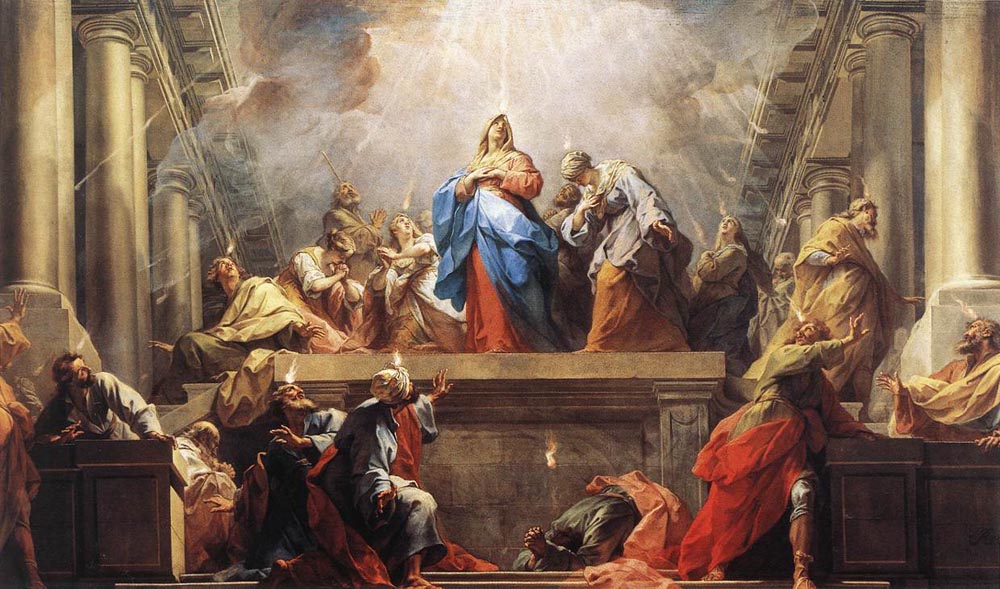
When the day of Pentecost had
come, they were all together in one place. And suddenly a sound came from
heaven like the rush of a mighty wind, and it filled all the house where they
were sitting. And there appeared to them tongues as of fire, distributed and
resting on each one of them. And they were all filled with the Holy Spirit and
began to speak in other tongues, as the Spirit gave them utterance. (Acts
2:1-4).
The above passage recalls the descent of the Holy Spirit
upon the Apostles and those disciples who were with them in the cenaculum – the
upper room in which the Last Supper also took place. This event is referred to
as ‘Pentecost’ and it takes this name because Pentecost was and is a Jewish
feast day, called Shavuot or the Feast of Weeks upon which thanksgiving was expressed
to God for the harvest. There is no coincidence as to why our Lord chose to
send forth the promised Spirit on this of all days.
The Giving
of the Law of Love
Jewish tradition also calls the Feast of Pentecost Matan
(Matin) Torah which means ‘giving of the law’, since it is believed this is
the very day upon which the law was given to the people of Israel through Moses
on Mount Sinai. Already a parallel can be seen, since in the Book of Jeremiah we
read:
Behold, the days are coming, says
the Lord, when I will make a new covenant with the house of Israel and the
house of Judah… this is the covenant which I will make with the house of Israel
after those days, says the Lord: I will put my law within them, and I will
write it upon their hearts; and I will be their God, and they shall be my
people. (Jer 31:31, 33).
 |
| Giving of the Law on Mt. Sinai |
Here in Jeremiah the sending of the Holy Spirit on
Pentecost is foretold. For just as on the day of Matan Torah when God
gave the people of Israel the law through Moses on Mt. Sinai, on Pentecost
Sunday God gave the new law to the New Israel the Church, through Jesus the New
Moses. The former foreshadowed the latter, and the latter did not supersede the
former, but expanded and fulfilled what was signified and possessed in
imperfection under the old covenant.
Whereas the former law was written on tablets and was a law
of fear to help turns hearts to God, the latter was written on the hearts of
believers by the anointing of the Holy Spirit, and is a law of love – of freedom
and grace – which consists of participation in Jesus, through Mary, in the life
of the Trinity. “For the law of the Spirit of life in Christ Jesus,” says St.
Paul, “has set me free from the law of sin and death.” (Rom 8:2). Through the
Sacrament of Confirmation, we participate in the grace of Pentecost Sunday, and
in a spiritual sense, we have perennial access to the grace of this day when
the Holy Spirit descended whensoever we desire it in faith.
St. Pope Leo the Great speaks exactly on this point, in a marvelous tone:
For from the day on which the Lord
ascended up above all heavenly heights to sit down at God the Father's right
hand, this [Pentecost Sunday] is the tenth which has shone, and the fiftieth
from His Resurrection, being the very day on which it began, and containing in
itself great revelations of mysteries both new and old, by which it is most
manifestly revealed that Grace was fore-announced through the Law and the Law
fulfilled through Grace. For as of old, when the Hebrew nation were released
from the Egyptians, on the fiftieth day after the sacrificing of the lamb the
Law was given on Mount Sinai, so after the suffering of Christ, wherein the true
Lamb of God was slain, on the fiftieth day from His Resurrection, the Holy
Ghost came down upon the Apostles and the multitude of believers, so that the
earnest Christian may easily perceive that the beginnings of the Old Testament
were preparatory to the beginnings of the Gospel, and that the second covenant
was founded by the same Spirit that had instituted the first.[1]
Adoption as
Children of God
The Holy Spirit anointing that fell upon the Apostles infused
the new law of grace of freedom into their hearts, and similarly this anointing abides in us
who have been baptised and confirmed - symbolised by the sacred chrism oil. This same very anointing is that which brings
about spiritual adoption as sons, as children, of God. St. Paul speaks of this
when he writes:
“For you did not receive the
spirit of slavery to fall back into fear, but you have received the spirit of
sonship. When we cry, "Abba! Father!" it is the Spirit himself
bearing witness with our spirit that we are children of God, and if children,
then heirs, heirs of God and fellow heirs with Christ, provided we suffer with
him in order that we may also be glorified with him.” (Rom 8:15-17).
Having considered Pentecost Sunday in general we will now
consider two spiritual nuggets which we will pull forth from the furnace of this feast.
Nugget
Number One: The Holy Spirit is Person
The Holy Spirit is often believed to be naught but an
impersonal energy force that is a manifestation of God’s power. The devotional
lives of many Christian reduce the Holy Spirit as something to be used for the
sake of an emotional high, for evangelism, or for the acquirement of some grace
and blessing. It is true, the Holy Spirit is the Advocate – our helper –
who brings us the bounty of God’s grace, and Who principally carries out our
sanctification and helps us to carry out our mission of continuing the life of
Christ for the glory of the Father.

But we must never forget the sacred truth that the Holy
Spirit is Person, He is not an abstract and impersonal energy force to
be used, but the Third Person of the Holy Trinity with whom we are also called
to enter into relationship with. In fact, the Holy Spirit is the
Relationship between Father and Son, He is the Love between Father and
Son, into whom we are called to “live, and move and have our being” (Acts
17:28). St. Pope John Paul II in his encyclical on the Holy Spirit wrote: “It
is the Holy Spirit who is the personal expression of this self-giving [between
Father and Son], of this being-love. He is Person- Love. He is Person-Gift”.[2]
and this Person-Gift we possess as our own as a bride possesses her groom – for
“when it is given, it is his to whom it is given”[3] – so
that we can love God the Father and the Son with the Holy Spirit. After all, “God's
love has been poured into our hearts through the Holy Spirit which has been
given to US” (Rom 5:5) – and this emphasis on US is made by the late Holy
Father himself.
On another level, keeping in mind the supreme reality
that the Holy Spirit is a Divine Person, and not an impersonal force; we ought
to ask Mary, the Spouse of the Holy Spirit, to teach us how to have a true
devotion to this Third Person of the Blessed Trinity. She is the expert at this,
because her union with the Spirit was so great, that the Word was able to come
forth in the flesh as the fruit of this mystical union. Indeed, the Holy Spirit
is the one who will conceive and bring forth the life of Jesus into our every act and our
entire being; and He will do this with, in and through the Virgin Mary with whom
He is in an indissoluble union of grace.
The Holy Spirit is a Divine Person, an equal member of
the Godhead, consubstantial with the Father and the Son. Yet how often do we say to
the Holy Spirit that we love Him, that we are grateful for His work in our
lives, and for His Presence which burns away the coldness of shame and sin? I
think it is common to use the Holy Spirit, but not to commune with Him.
One can only see for themselves the beauty such devotion brings forth when at
last the Holy Spirit is welcomed into the house of one’s soul as Gift, Friend
and Spouse, as He was welcomed into the house of the upper room.
Nugget Number Two: The Holy Spirit - Completer of the Paschal Mystery
There’s a tremendously deep phrase in the concluding
prayer for Evening Prayer I of Pentecost Sunday in the Divine Office. “Almighty,
ever-living God, you ordained that the paschal mystery be completed by the
mystery of Pentecost.” The Paschal Mystery is the life, death and resurrection of
Christ – it’s the mystery of redemption. What is significant is that here we
come to realise that the Paschal Mystery – Christ’s life, to keep it simple –
does not end on Easter Sunday, nor with His Ascension into heaven, but on
Pentecost Sunday when the Holy Spirit was sent from above. What was Pentecost?
It was the day the Apostles were anointed by the Spirit and commenced their mission
of carrying out their commission to preach the Gospel to the ends of the
earth. Pentecost as such, is seen as the birthday of the Church – the Church
who we might say was conceived when Christ was conceived, and which was born on
Calvary through the birth pangs of the New Eve who is Mary, but a birth which manifested
itself and came to fruition on Pentecost Sunday.
 |
| The Holy Trinity with Jesus in the Eucharist |
Therefore, we have an interesting paradox – Pentecost is
the completion, the ending of the Paschal Mystery and yet the beginning of the
life of the Church – which is the Mystical Body of Christ. Yet these two mysteries
– the Paschal Mystery and the Mystery which is the Church – are inseparable,
and we could say that Pentecost marks both the completion of the Paschal
Mystery in the First Coming of Christ, and which marks the beginning of the
Paschal Mystery in the life of the Church who is called throughout the ages,
until Christ comes again, to live out, and to live in, the Paschal Mystery –
the Life, Death, and Resurrection of Christ.
We cannot forget either, that the outpouring of the Holy
Spirit took place in the upper room wherein the Last Supper was held. This
reveals to us the role of the Holy Spirit in the life of the Church, and in
regards to the mystery of the Holy Eucharist which is the first fruit of the
spiritual harvest of the redemption – a first fruit which, like the first
fruits of grain given to God by the Israelites (Lev 23:15-16), we give to God
the Father in thanksgiving for the season of this life, and for the eschatological
season of harvest which will arrive on that Last Day when, by the grace of the
Good Lord and trusting in His Mercy, we will be gathered like sheaves of wheat
into the barn of eternal beatitude.
 |
| The Pentecost, El Greco, 1596-1600. |
The Holy Spirit completes the Paschal Mystery. Ah
yes, this is in some way a euphemism for how the Holy Spirit works to complete
our sanctification which in a mysterious manner has already been completed in
the Person of Christ (Heb 10:14). Yet again, this paradox of completion in
Christ, and beginning and process in the Church is made apparent. We are called
as members of Christ’s Body to enter into the Paschal Mystery, to make the acts
of Christ our own, and to let Him make our acts His own. We have to consume Him
in the Eucharist, and we have to let Him consume us. The Holy Spirit is the
Person who is the Means by which this sacred communion takes place between
ourselves and our Lord Jesus Christ. For it is He who unites us to the Paschal
Mystery, a union of participation which is limitless. And He does this through
His Divine Indwelling and His seven gifts that abide in us as grafted powers
moved by God’s very Self.
Conclusion
Pentecost Sunday is a joyful day. It is a day on which we
are called to especially invoke the Holy Spirit in our lives. To invite Him to
burn what is contrary to the Will of God within our souls. This burning is not
destructive, but creative. Since as God, the Holy Spirit is Creator in union
with the Son, and with the Father whose prime work is as Creator. The Spirit
came upon the Apostles in the form of fire since He is a Spiritual Fire that
burns and renews. In the Australian bush, fire is necessary to rejuvenate the
flora, and so too in our souls, the spiritual bush fires of the Holy Spirit rejuvenate
the flora of our acts, desires and virtues – divinising them and making them
sprout anew.
It is Mary to whom we must turn for these mystical showers
of fire, since She is the Burning Bush that blazed alight with the Love who is
the Holy Spirit; and like Her, we too are called to be such burning bushes who
with “love within our hearts / Set fire to others with its [the Holy Spirit’s]
flame.”
[1]
Leo the Great, Sermons of St. Leo the Great, On Whitsuntide, I, sermon
75, http://www.newadvent.org/fathers/360375.htm.
[2]
John Paul II, Dominum et Vivificantem, Encyclical on the Holy Spirit in
the Life of the Church and the World, 1986, http://w2.vatican.va/content/john-paul-ii/en/encyclicals/documents/hf_jp-ii_enc_18051986_dominum-et-vivificantem.html.
[3]
Thomas Aquinas, Summa Theologica, I, 38:2, ad. 3.


