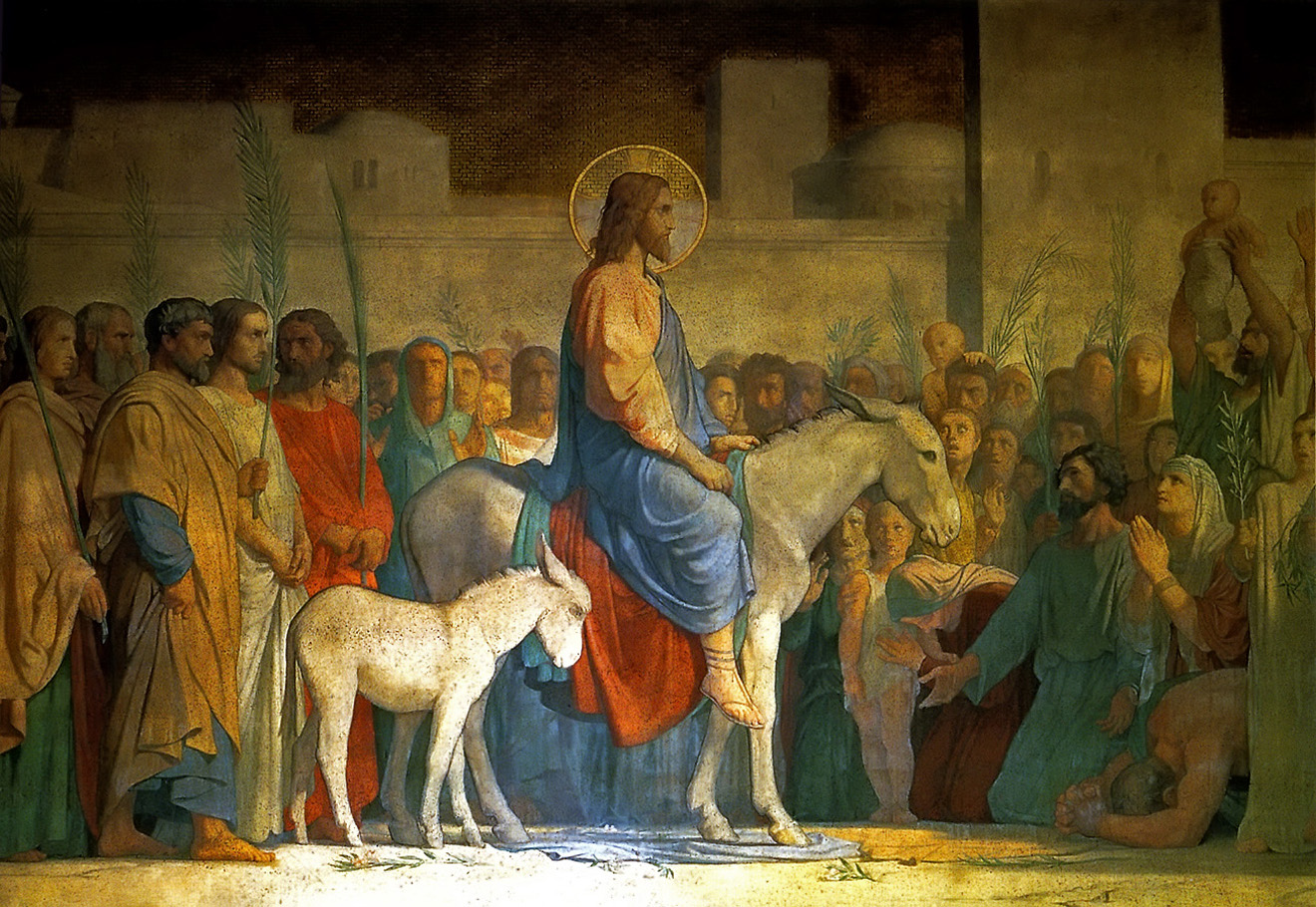
As practicing
Catholic’s we have all attended countless Palm Sundays. We go to church as per
usual [well not this year!], yet this time we’re given a palm or olive branch [or whatever branch we have in our backyard...]. We then take our seats
and just as we’re getting comfortable we are usually ushered out of the church
where we hear the first of two Gospel’s read aloud. We then make a procession –or
at least something resembling a procession, into the church. Mass then proceeds
as usual except for the fact that the Passion Narrative is read as the Gospel. We
carry out these motions with generally a vague understanding that we are
commemorating the triumphant entry of Jesus into Jerusalem; where the crowds
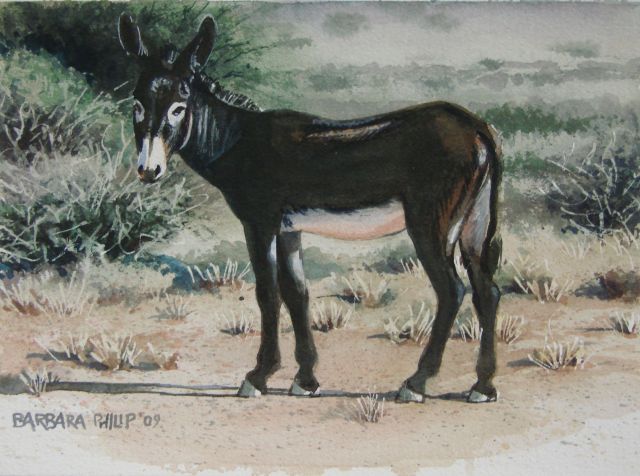
welcomed him, hailing Him as king, as He rode upon the back of a donkey. In the
Gospel of Mark we read:
And many spread their garments on the road, and others spread leafy
branches which they had cut from the fields. And those who went before and
those who followed cried out, “Hosanna! Blessed is he who comes in the name of
the Lord! Blessed is the kingdom of our father David that is coming! Hosanna in
the highest!” (Mark 11:8-10).
How
easy it is to go through the liturgical celebrations of Advent and Lent, even
Mass every weekday or Sunday, without ever entering into the Spirit, the inner meaning and spiritual reality behind all the
hymns and postures. [Edit: During this year's quarantine we have no choice but to enter the spirit of things!]. What meaning can we draw from this Palm
Sunday’s celebration? Something spiritual and practical; something insightful and
intriguing. Let’s explore a few such meanings that may enrich our interior-life,
and deepen our inner-participation in the Palm Sunday celebration –whether we
have already been this year or not; and for Holy Week which lies ahead of us.
The Entry of Jesus into
Jerusalem Foreshadowed by Solomon
 We often
treat the Old Testament as if it were nothing but an unwanted leftover
freezer-meal. We take out the Psalms and defrost them, but we deal as little as
we can with the rest of ‘that old thing’. Yet as the Catechism puts it, drawing
from Augustine: “the New Testament lies hidden in the Old and the Old Testament is
unveiled in the New” (CCC 129). So it is that in reality the New Testament is
like a main meal, and the Old Testament like an entrée which
embellishes and accentuates the flavours of this meal. These two are so inseparable
that if we were to divide them, the main meal of the New Testament would be
tasteless and bland in comparison to the delight we would draw if we kept the entrée of the Old Testament in its rightful place. After all, doesn’t an
entrée whet one’s appetite for the meal that follows? And does not one’s
restaurant experience lack if an entrée is forgone?
We often
treat the Old Testament as if it were nothing but an unwanted leftover
freezer-meal. We take out the Psalms and defrost them, but we deal as little as
we can with the rest of ‘that old thing’. Yet as the Catechism puts it, drawing
from Augustine: “the New Testament lies hidden in the Old and the Old Testament is
unveiled in the New” (CCC 129). So it is that in reality the New Testament is
like a main meal, and the Old Testament like an entrée which
embellishes and accentuates the flavours of this meal. These two are so inseparable
that if we were to divide them, the main meal of the New Testament would be
tasteless and bland in comparison to the delight we would draw if we kept the entrée of the Old Testament in its rightful place. After all, doesn’t an
entrée whet one’s appetite for the meal that follows? And does not one’s
restaurant experience lack if an entrée is forgone?
 |
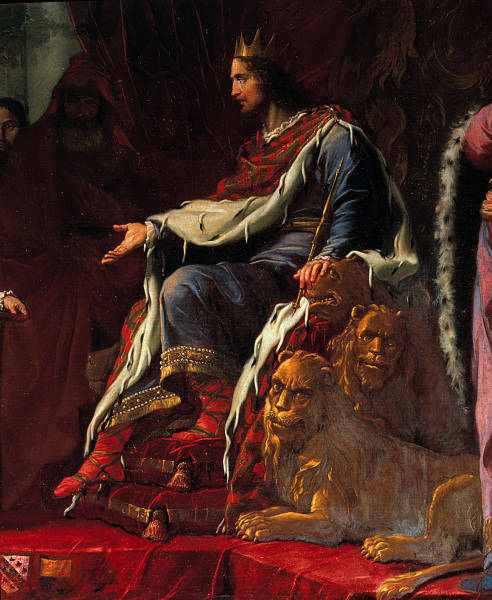
| King Solomon |
This is made
readily apparent to us when we take a look at the First Book of Kings. The
context of this particular passage is as follows. King David is at the end of his
days. After a long reign of forty years, of defeating enemies, writing psalms
and dealing with a few hiccups of his own, the time comes for a new king, a
replacement king to be announced. David himself had intended and had promised
to his wife Bathsheba that their son Solomon, although not his eldest, would be
his heir to the throne.
However Adonijah - the fourth son of David and older
than Solomon - had other plans. He himself wanted to be king. So he
gathered supporters and held a feast where those present shouted: “Long live
King Adonijah!” (1 Kings 1:25). Adonijah “did not invite Nathan the
prophet or Benaiah or the mighty men or Solomon his brother.” (1 Kings 1:10). When
the prophet Nathan heard what was happening he informed Bathsheba the wife of
David, and together in a round-about way addressed the king so that he would be
urged to act swiftly in making Solomon king, before he himself had even passed
away, so that Adonijah’s kingship would be blotted out and exposed as illegitimate
according to King David’s decree. It is at this point David speaks,
giving his command to be carried out for Solomon’s anointing and
enthronement as the new King of the Kingdom of Israel.
“Take with you the servants of your lord, and cause Solomon my son
to ride on my own mule, and bring him down to Gihon; and let Zadok the priest
and Nathan the prophet there anoint him king over Israel; then blow the
trumpet, and say, ‘Long live King Solomon! … So Zadok the priest, Nathan the
prophet, and Benaiah the son of Jehoiada, and the Cher'ethites and the
Pel'ethites, went down and caused Solomon to ride on King David's mule, and
brought him to Gihon. There Zadok the priest took the horn of oil from the
tent, and anointed Solomon. Then they blew the trumpet; and all the people
said, ‘Long live King Solomon!’ And all the people went up after him, playing
on pipes, and rejoicing with great joy, so that the earth was split by their
noise. (1 Kings 1: 33-34, 38-40)
With the
spectacles of our Christian faith we can clearly see how this Old Testament event
is a foreshadowing and prefigurement of Christ’s triumphant entry into
Jerusalem. Often we hear it said: ‘Despite Christ coming on a donkey the people
clapped and welcomed Him as their king in the line of David, and thus as the
promised Messiah’. However considering that the Jewish people would have been
well aware of the story of Solomon and how he had ridden on a donkey, it would
not be farfetched to believe that at least some of the Jews might have put two
and two together. Thus with His reputation as a miracle worker (Jn 12:18), seeing
Jesus riding on a donkey into Jerusalem could have been one of the very factors
instigating the people to acclaim Him as their king. Yet despite this possibility,
the actual disciples of Jesus were not aware since in John’s Gospel we read: “His
disciples did not understand these things at first; but when Jesus was
glorified, then they remembered that these things had been written of him and
had been done to him.” (Jn 12:16).
Reading the
Gospel accounts of Christ’s triumphant entry into Jerusalem (Mt 21:1-11; Mk
11:1-11; Lk 19:28-40; Jn 12:12-19) in the light of Solomon’s rite of coronation
reveals to us great insights.
The main
purpose of Solomon becoming king, besides continuing the Royal House (lineage) of
David - which God promised would endure forever (2 Sam 7:11-16) - was to
build the house of God, the temple for God. We see this in the words spoken by to David:
“When your days are fulfilled and you lie down with your fathers, I
will raise up your offspring after you, who shall come forth from your body,
and I will establish his kingdom. He shall build a house for my name, and I
will establish the throne of his kingdom for ever.” (2 Sam 7:12-13).
This promise
made to David was partly fulfilled in Solomon, but not fully, since Solomon,
the temple he built, and his reign, were only temporal. Solomon eventually died, the temple was eventually destoryed, and the kingly line of David, at least to a manifest degree, if not completely, died out.
The Fathers of the
Church teach that the above Scripture was totally fulfilled in Jesus – a descendant
in the flesh of King David. Jesus’s heavenly kingdom is eternal, and so is
His reign and the Temple which is His Body – both literally, having being raised in glory from the dead, and mystically, with regard to His Body the Church.
 |
| Solomon's Temple |
What does Jesus do the first thing after He arrives in
Jerusalem? “And he entered Jerusalem, and went into the temple” (Mk 11:11a). It
is there in the temple that he “began to drive out those who sold, saying to
them, ‘It is written, ‘My house shall be a house of prayer’; but you have made
it a den of robbers.’” (Lk 19:45). This clearing of the temple is the second
time Jesus cleanses the temple, and is connected with the first time Jesus
cleansed the temple at the beginning of His three-year ministry. Following the
first cleansing we read in the Gospel of John:
“The Jews then said to him, ‘What sign have you to show us for doing
this?’ Jesus answered them, ‘Destroy this temple, and in three days I will
raise it up.’ The Jews then said, ‘It has taken forty-six years to build this
temple, and will you raise it up in three days? But he spoke of the temple of
his body.” (Jn 2:18-21).
Jesus the New Solomon
 |
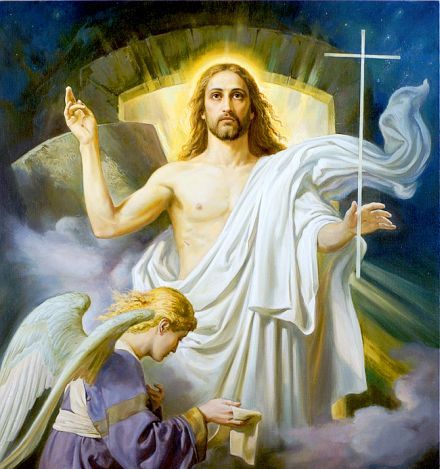
| The Risen Lord |
Linking these
various portions of Scripture together we come to learn that Jesus is the New
Solomon. While Solomon became king in order to continue the lineage of
David and to build a physical and temporal Temple for God, Christ has come in
order to continue and fulfill God’s promise made with David; since our Lord is
the King of Heaven and Earth who has established the everlasting Kingdom of David,
an allegorical title for the Kingdom of God.
Christ has also come in order to
build an eternal and spiritual Temple. This Temple is His Body which was raised
from the dead, and includes the mystery of the Church which is the Mystical
Body of Christ, since we are “living stones” that have been “built into a
spiritual house, to be a holy priesthood, to offer spiritual sacrifices
acceptable to God through Jesus Christ.” (1 Pet 2:5). This after all is what
Christ really meant when He said: “My house shall be a house of prayer” and that
the time is coming “when neither on this mountain nor in Jerusalem will you
worship the Father…But the hour is coming, and now is, when the true worshipers
will worship the Father in spirit and truth, for such the Father seeks to
worship him.” (Jn 4:21, 23).
The Kingly Anointing and Coronation
of Christ and Solomon
In ancient
Israel/Judah the king had to be anointed in order to be a legitimate king. In
Israel/Judah this anointing had to be carried out by a prophet and/or the high
priest. Solomon was first led on a donkey, anointed by Zadok the priest and then
he was enthroned on the throne of David his father (1 Kings 1:33-35, 38-39). Thus
Solomon’s anointing came after he had rode upon the donkey to Gihon. However
Christ was anointed before He rode upon the donkey to Jerusalem, after which
followed His enthronement on the throne of the Cross at Calvary, whilst wearing
the crown of thorns.
How do we know Jesus was anointed before riding
triumphantly into Jerusalem amidst the crowd’s Hosannas? Because immediately
before this takes place we read in the text that Jesus is anointed by Mary, and
this is recorded as taking place the day before Jesus rides into Jerusalem (Jn
12:12-13).
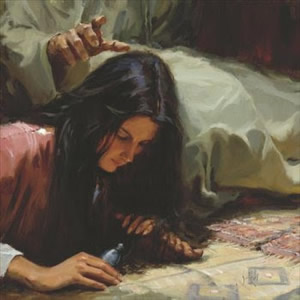
Mary took a pound of costly ointment of pure nard and anointed the
feet of Jesus and wiped his feet with her hair… [Judas then retorts and Jesus
begins His response by saying:] "Let her alone, let her keep it [the ointment]
for the day of my burial. (Jn 12:3,7).
This same
very account is described in the Gospel of Matthew, where we read that not only
did Mary (whom tradition has associated with Mary Magdalene) anoint Jesus’
feet, but also His head:
A woman came up to him with an alabaster flask of very expensive
ointment, and she poured it on his head (Mt 26:7).
 |
| Mary Anoints Jesus' Feet |
Unlike
Solomon who was anointed by a high priest, Jesus was anointed by a repentant
woman. Solomon is anointed by Zadok the High Priest and it is this anointing
that makes him king, yet Jesus (the Eternal Great High Priest) is anointed by a
repentant woman because this anointing doesn’t make Him King, but is a sign of
His inherent Kingship which He possessed before all time as God,
manifested in His manhood at His baptism when the Holy Spirit anointed Him in
the form of a dove alighting above His head. Not only this, but Jesus’
anointing by Mary is a sign of the type of coronation which Jesus will undergo
– a coronation which is at once an execution and which will lead to His death
and burial. Jesus alludes to this fact quite plainly when He says: “Let her
alone, let her keep it for the day of my burial.”
Another
contrast is that while Solomon rode out of Jerusalem on a donkey to
Gihon, and was then anointed king, Jesus was anointed and then rode into Jerusalem
on a donkey. Jesus’ fulfillment of what is foreshadowed by Solomon eight
hundred to a thousand years earlier is thus an inversion of the events that
took place. Perhaps such an inversion of events is a sign and indicator that
what Solomon is not (i.e. an eternal king, the one who is to establish
the kingdom of God, and build the eternal Temple), Jesus is.
The Royal Throne
Once the
coronation of any king takes place, the king then sits on the throne as a sign
of the consolidation of His kingship, and of His power over, and guardianship
of, His kingdom. Following Solomon’s anointing, he is led amidst jubilant
shouts into Jerusalem where he then sits on the throne, concerning which the
Scripture reads: “Solomon sits upon the royal throne.” (1 Kings 1:46). Likewise
with Christ, shortly after His triumphant entry into Jerusalem He, like
Solomon, takes His place at the Throne of His Kingdom. Yet whilst Solomon’s
throne was a majestic and comfortable seat, Jesus’ throne was the Cross: "And over his head they put the
charge against him, which read, 'This is Jesus the King of the Jews'" (Mt 27:37).
Jesus the King, Mary the Queen Mother, and the Princes and
Princesses
When Solomon
became King he appointed his mother Bathsheba as the Queen, so that she became
‘the Queen Mother’. We read of this in the First Book of Kings: “then he
[Solomon] sat on his throne, and had a seat brought for the king's mother
[Bathsheba]; and she sat on his right.” (1 Kings 2:19). This same very passage
allegorically refers to when Jesus was nailed to the Cross, and when Mary was
there with Him, sharing and participating in Her Son’s primal role as Redeemer,
with Mary acting as Co-Redemptrix. Thus we can read: “then he [Jesus] sat on
his throne [the Cross], and had a seat brought for the king's mother [Mary];
and she sat on his right.” (1 Kings 2:19). For although Mary was not literally
nailed to the Cross to Jesus’ right, indeed Mary was spiritually nailed to the
Cross on Jesus’ right – the ‘right hand side’ in Judaism representing the key
place of honour. Hence just as Bathsheba participated in Solomon’s running of
the united Kingdom of Israel, so too Mary participated in Jesus’ running of the
spiritual Kingdom of Israel – the Church, in the past, present, and future.
 On
the Cross Jesus carried out His kingly role of judge – excusing everyone of
their faults – “Father forgive them, for they know not what they are doing” (Lk
23:34). Mary, as the Queen Mother of the Kingdom of God, the Church, shared in
this role of Christ, by suffering in, with and through Him – orchestrating from
Her place, beside the enthroned Crucified Christ, Her role of dispensing the
redeeming blood of forgiveness to all souls, past, present and future – begging
each and every soul to accept this royal gift.
On
the Cross Jesus carried out His kingly role of judge – excusing everyone of
their faults – “Father forgive them, for they know not what they are doing” (Lk
23:34). Mary, as the Queen Mother of the Kingdom of God, the Church, shared in
this role of Christ, by suffering in, with and through Him – orchestrating from
Her place, beside the enthroned Crucified Christ, Her role of dispensing the
redeeming blood of forgiveness to all souls, past, present and future – begging
each and every soul to accept this royal gift.
Those who do
accept this gift of Christ’s Royal Blood from Mary, become themselves royal as
God’s adopted children in Christ (Eph 1:5). For by accepting the forgiveness of
Jesus in prayer and Confession, and by taking His Blood, which the Catholic can
receive through desire and sacramentally in Holy Communion, the believer
undergoes a divine blood transfusion as it were, by which peasant blood is
replaced with royal blood. So that what is Jesus’ by Divine Right as Eternal
King, becomes the inheritance of the believer who has become in Christ a King in
Him, or if you would, a prince (or princess) destined for the royal court
of heaven.
Hosanna in
the Highest
Jerusalem and
its crowd were fickle – lauding Jesus as King one moment, by shouting “Hosanna
in the highest, blessed is he who comes in the name of the Lord” and “Crucify
Him, crucify Him” only a few days later. On an allegorical level Jerusalem is
often employed as referring to Mary or to the individual soul. The Jerusalem
who is Mary, received Jesus as a King into her womb at the Incarnation, and She
never turned on Him unlike the people of Jerusalem. The Jerusalem of our own
souls has been fashioned in order to receive the King of Kings. “Lift up your
gates, O ye princes, and be ye lifted up, O eternal gates: and the King of
Glory shall enter in.” (Ps 24:7). That is, open your hearts in desire and thanksgiving,
O ye princes and princesses, and take hold of the receptivity of Mary the Immaculate
Gate as your own: and the King of Glory, the Lord of Lords, Jesus Christ, shall
enter within your heart, and shall establish His Kingdom therein – so that a
peace and joy that the world cannot give will be established within.

As the people
of Jerusalem laid down their garments and palm branches, so too we must lay
down our agendas and affections before the Lord. As He rode on an ordinary donkey
into Jerusalem, so too He rides hidden beneath the ordinary appearance of bread
and wine when He comes into our souls in Holy Communion; and so too He rides
hidden beneath the ordinariness of everyday and every moment in order to enter
more deeply within us. Ultimately Jesus wants to bring us with Him to be there at Calvary, side by side with His Queen Mother, so as to join Him in making
reparation for sins and in labouring for the salvation of souls, so that all
might come to taste the heavenly bliss of the Eternal Easter Morning.